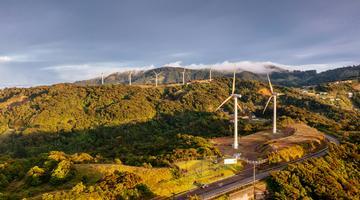
Wind Park Chemin de Valenciennes
The Chemin de Valenciennes wind farm is located in Haussy, in the Hauts-de-France region, in northern France.
Constructed between 2022 and 2023, the Chemin de Valenciennes wind farm was inaugurated in May 2024, and consists of four Vestas wind turbines, each with a capacity of 3 MW, a diameter of 112 metres and a total height of 150 metres. The total installed capacity of 12 MW allows the wind farm to supply electricity equivalent to the needs of approximately 14,800 people, cutting more than 16,100 tonnes of CO₂ emissions annually. The project complements the nearby La Chaussée Brunehaut wind farm that is in operation since 2016; both farms have been constructed by JP Energie Environnement (JPee), an independent French renewable energy company.
The project design aligned with the Plan de Développement d'ENR (Plan ENR) (Plan for the Development of Renewable Energies), which was adopted in 2018 by the intermunicipal authority Communauté de Communes du Pays Solesmois (CCPS), to comply with the 2020 targets set out in the Schéma Régional du Climat, de l’Air et de l’Énergie (SRCAE) of the Hauts-de-France region. The Plan ENR promotes the responsible development of renewable energy across the territory through an innovative planning framework introduced the same year. Under this framework, the intermunicipal authority assumed the discretionary competence for the planning and operation of wind energy installations. This enables CCPS to support and co-finance renewable energy projects while redistributing the associated financial benefits among its member municipalities through a solidarity-based approach.
Following a competitive inter-municipal call for projects in 2018, JPee was selected as partner for the implementation of the Chemin de Valenciennes project. A Memorandum of Understanding was established between JPee and CCPS, governing a new simplified joint stock company created for the development, co-financing, construction, commissioning, operation and maintenance of the wind farm. The agreement envisaged for the inter-municipal authority to acquire up to 49.9% of the shares in the new company, with the remaining 50.1% held by the wind farm developer JPee.
The collaboration between JPee and CCPS ensured strong engagement with the local municipality throughout the project development and facilitated the meaningful participation of the local community. JPee’s distributed informative letters to all residents of the municipality of Haussy inviting residents to a public dialogue in January 2019 which was also promoted at Haussy Town Hall and on the project website. In addition, residents could access the project presentation files both the Town Hall and online. Overall, these activities provided access to project information and a certain level of transparency.
In terms of benefit sharing scheme, once the project was approved, CCPS sold part of its shares in the project to allocate them according to the principle of inter-municipal solidarity mentioned above. According to the President of CCPS, Paul Sagniez, 30% of these shares were dedicated to financing the construction of the wind farm, 30% were distributed to member municipalities to support local initiatives such as infrastructure, equipment, and public services, and 40% were earmarked for community projects dedicated to energy transition. In line with the Fast and Fair Principles, this approach ensures that financial benefits are tangible, proportionate, and aligned with the needs and priorities of the local community.
Beyond the sale of electricity, the project is expected to generate approximately €264,000 per year in terms of taxes and property-related revenues for the region and municipalities, thereby reinforcing local public service provision and community development. According to Jean-Marc Boucly, Mayor of Haussy, the revenues from the wind farm were intended to fund a public health centre and a family school. Such initiatives demonstrate how benefit-sharing mechanisms can contribute to local welfare, foster a sense of ownership, and strengthen public support for renewable energy infrastructure.
Sources:
Communauté de Communes du Pays Solesmois (CCPS)(2018). Rapport d’activités 2018 https://www.ccpays-solesmois.fr/wp-content/uploads/2020/06/rapport_activite_ccps_2018.pdf
Environmment Magazine. (2024, 3 June). Environmment Magazine. Un parc éolien en co-développement et co-investissement public-privé dans le Nord. Territoires, accessible at https://www.environnement-magazine.fr/territoires/article/2024/06/03/149066/parc-eolien-codeveloppement-coinvestissement-publicprive-dans-nord
France renouvelables. (2025, 14 October) Éolien et photovoltaïque.Paroles d'élus 2025 - Énergies locales, retombées locales. Retrieved from https://www.france-renouvelables.fr/etudes-et-publications/paroles-delus-2025/ accessed 12.02.26
JP Energie Environnement. (2024, 31 May). Communiqué de presse. JP Energie Environnement inaugure dans le Nord un parc éolien en co-développement et co-investissement public-privé. Retrieved from https://www.jpee.fr/inauguration-le-parc-eolien-du-chemin-de-valenciennes-dans-le-nord-a-ete-inaugure/ accessed 12.02.26
JP Energie Environnement. Project website https://chemin-valenciennes-59.parc-eolien-jpee.fr/
Ministère de la Transition Écologique et de la Cohésion des Territoires. Fiche du projet — Chemin de Valenciennes. Retrieved from https://www.projets-environnement.gouv.fr/page/fiche/?q=recordsid:20191001229 accessed 12.02.26
PELEIA35 and JP Energie Environnement. (2019, 2 July). Projet éolien du Chemin de Valenciennes. Dossier de demande d’Autorisation Environnementale. Volume 4a: Résumé non technique de l'étude d'impact sur l'environnement et la santé. Version n°2. Juillet 2019. Retrieved from https://sicodei.projets-environnement.gouv.fr/2025/06/18/1001229/1001229_RNT.pdf accessed 12.02.26